

The Hindon:
A Story of the Dead River
Understanding water stress through environment, society, and human impact
Scroll Down

Source


The Hindon river is a 400 km long, rain-fed tributary of the Yamuna river in North India, originating from Shivalik hills in the Saharanpur district to Ghaziabad, Uttar Pradesh before joining the Yamuna near Noida.
Uttar Pradesh, India
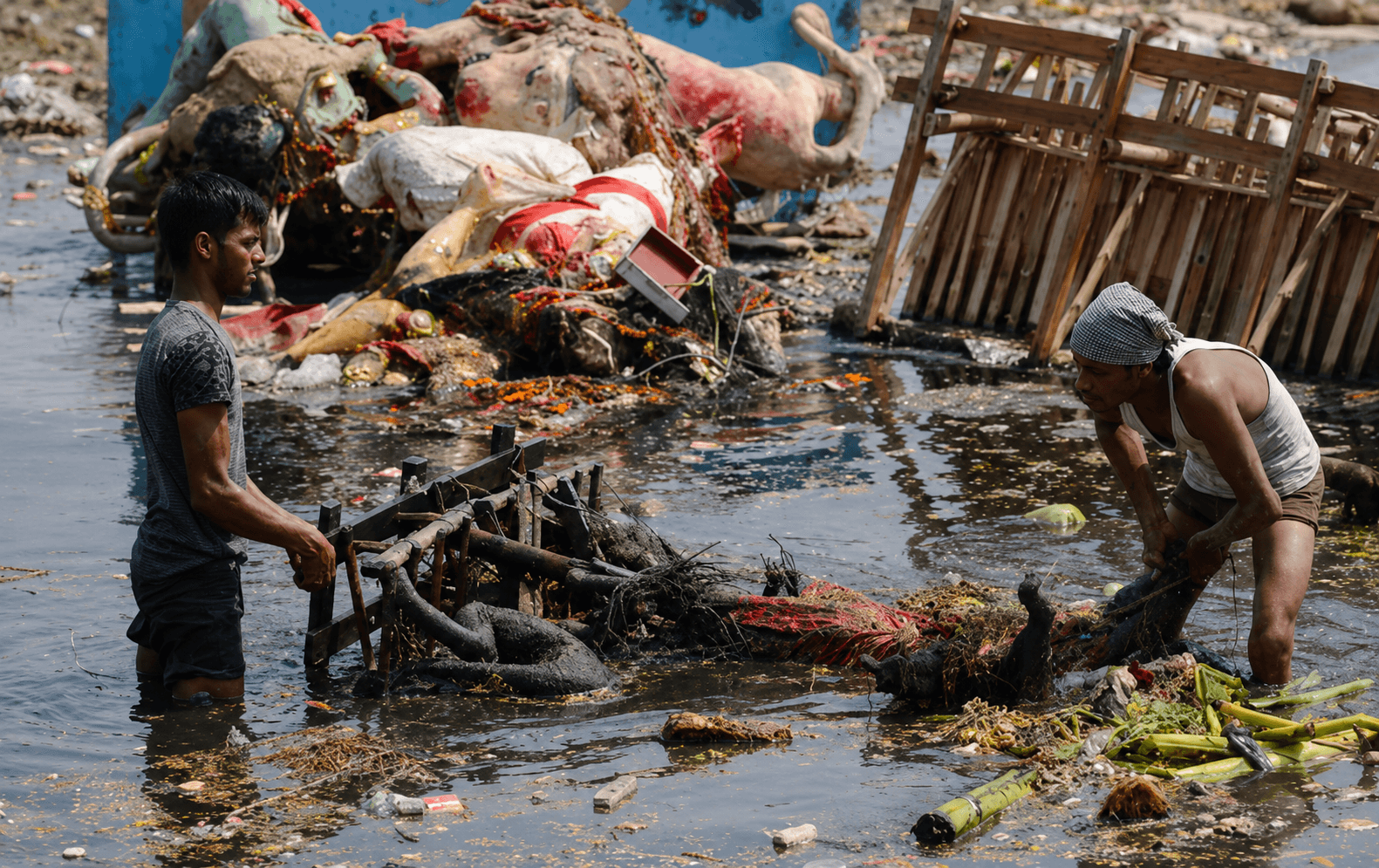
Source : Hindustan Times
Source
What is a Dead River?
The dead river means when it can no longer support healthy aquatic life, provide clean water, or maintain its natural ecological balance. This usually happens because of long-term human activities combined with environmental changes.
02
03
04
05
01
There are 5 major reasons for the death of the river
Types of dead rivers
The Hindon River is considered "dead" (declared so by the CPCB in 2015) due to severe industrial pollution, untreated sewage disposal, and dangerously low dissolved oxygen levels.
"The Hindon river is a 400 km long river, entirely declared dead by the The Central Pollution Control Board (CPCB) in 2015. "
Once a life line, now a ‘dead river’
Scroll Down

High to low BOD

Meerut, UP
Mohan Nagar, UP
Saharanpur, UP
Barnawa, UP
Mohan Nagar
Ghaziabad
Barnawa
Meerut
Ghaziabad, UP
Maheshpur, UP
Life support system weakened by chemical exposure and its impact.
When chemicals enter into hindon, the “BOD level” (Biochemical oxygen demand), which shows how much oxygen is needed by bacteria and microorganisms to decompose organic waste in water, increases across the entire basin, especially in the downstream areas of Ghaziabad and Meerut.


Biochemical Oxygen Demand exceeded 30 mg/L
Drop in Dissolved Oxygen (DO) levels
High Chemical Oxygen Demand (COD)
Total Dissolved Solids (448–1617 mg/L)
Toxic heavy metals entered the river


The journey of the Hindon River is divided into three chapters to understand how it became a dead river, its impacts, and the possibilities of restoring it.
Not just a dead river
It’s a warning.

@Hindon River Project 2026


@MDes Dau 2026 Final Thesis Project 2026
Connect to help
Can we restore it back?
What died with Hindon ?
How did Hindon die?
Home Page
Location


3–5 mg/L (Fair/Good)
1–2 mg/L (Very Good)
10+ mg/L (Highly Polluted)
6–9 mg/L (Poor)
BOD Water Quality Classification
Scroll Down
Upper Stream
Middle Stream
Lower Stream
Alex Morgan
Once a life supporter, the river now struggles to support life itself.
Upper stream (Saharanpur and Shamli districts region): The river once carried childhood, prayers, laughter, and life along its flowing streams, where clean water touched everyday human moments. In this upper stretch around Saharanpur and Muzaffarnagar districts, people lived closely with it, bathing, playing, and depending on its purity.
Once a thriving river of western Uttar Pradesh, Hindon has been officially classified as “dead” (by the CPCB in 2015) due to extreme pollution and loss of oxygen.
Why Hindon is declared dead river ?
(by the CPCB in 2015)
Menu
0%

Source
Source
Source
Source
Source